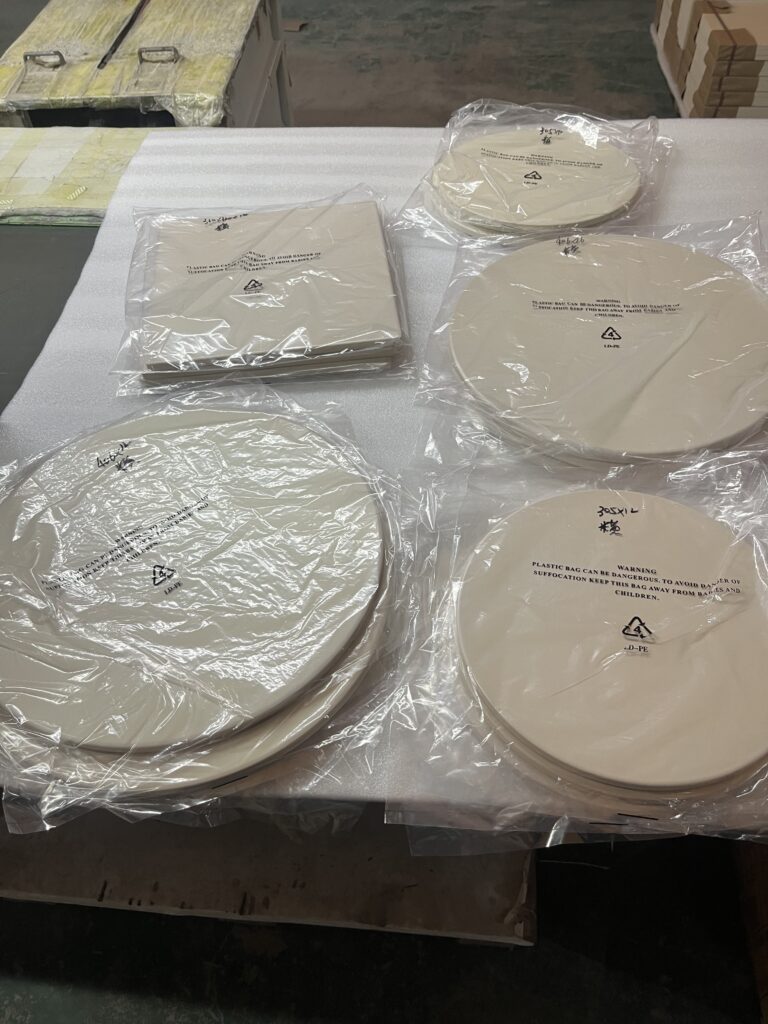
If you run a pizzeria, camping site, outdoor grill shop or source cookware wholesale for the European market, you already know: a reliable pizza stone is not just a flat ceramic disc. Consistent heat retention, thermal shock resistance and low cracking rate decide your customer reviews and repeat orders.
Behind every stable, restaurant-ready pizza stone is a controlled, repeatable production line. Below we walk you through every stage of our cordierite pizza stone manufacturing process, so you understand what you get when you place bulk OEM orders with our factory.
Step 1 – Raw Material Screening & Formula Mixing
Cordierite is our core material for commercial pizza stones, famous for outstanding thermal shock resistance — the critical feature that stops stones cracking when cold dough hits a 450°C kamado grill or pizza oven.
We source qualified cordierite mineral powder, blended with refractory clay and binding agents in fixed proportions. Our lab tests every batch of incoming raw material first:
- Check mineral purity, iron content and particle size
- Verify thermal expansion coefficient
- Remove impurities that cause black spots, bubbles or structural weakness after firing
All ingredients go into automated ball mills for even mixing. Uniform mixing ensures every stone from the same batch shares identical heat performance, which is essential for busy pizzerias baking back-to-back pizzas all day.
Step 2 – Hydraulic Compression Moulding
After homogenisation, the mineral mixture is fed into high-pressure hydraulic presses.
We support custom dimensions: round, rectangular, square, thick or slim stones matching kamado grills, built-in pizza ovens and domestic ovens. Moulds can be engraved with your brand logo, anti-slip texture or surface grooves upon OEM request.
High-pressure compression removes trapped air inside the blank. Low-pressure hand-mixed stones often contain hidden air pockets, which crack easily under rapid temperature swings. Our pressing process creates dense, stable blanks with even thickness across the whole surface.
Step 3 – Slow Controlled Drying
Fresh pressed stone blanks hold residual moisture. Fast drying is the most common mistake many low-cost factories make. Uneven moisture loss leads to invisible micro-cracks that only show up after your end customers preheat the stone.
We place blanks in climate-controlled drying rooms for gradual water evaporation, over multiple days. Temperature and humidity are monitored 24 hours to release moisture slowly and evenly. Drying is finished only when moisture content hits our standard threshold before firing.
Step 4 – High-Temperature Kiln Firing
This is the stage that turns a soft mineral blank into a solid, food-safe baking stone.
Dried blanks are stacked carefully in tunnel kilns and fired at a stable high temperature, following a pre-set heating, holding and cooling curve. Slow ramp-up and controlled cooling are non-negotiable for cordierite products.
Firing permanently locks the mineral structure, delivers excellent heat retention and makes the stone safe for repeated cycles from room temperature up to 500°C+. This firing profile is why our stones work reliably in kamado grills, wood-fired pizza ovens, gas barbecues and commercial restaurant ovens.
Step 5 – Grinding, Edge Finishing & Surface Treatment
Once fully cooled, stones move to finishing. Workers sand flatness, grind sharp edges into smooth rounded bevels and remove burrs. Rough sharp edges are a common complaint from retail buyers and kitchen staff, so this step is mandatory for all wholesale orders.
We offer two surface options for B-side buyers:
- Natural unglazed porous surface: absorbs excess dough moisture for crispy Neapolitan pizza crust, the top pick for pizzerias
- Light sealed glaze finish: easier to wipe clean, preferred by home users and glamping sites
Custom texture lines, branding engraving or laser logos are applied here for private label OEM orders.
Step 6 – Multi-Stage Quality Control (QC)
Quality checks run at every production checkpoint, with a final full inspection before packing:
- Visual screening: spot cracks, chipping, bubbles, colour marks and deformation
- Flatness & thickness measurement with gauges for batch consistency
- Sampling thermal shock test: heat samples to high temperature then cool rapidly to simulate real restaurant use
- Food safety test compliance for EU market requirements
Defective pieces are separated and recycled, never mixed into wholesale shipments. For large commercial orders, we can provide batch test reports for your EU import and retail documentation.
Step 7 – Custom Packing & Bulk Shipment
We tailor packaging solutions based on your sales channel:
- Brown export cartons + foam protection for wholesale distributors
- Colour retail boxes with your artwork for supermarket and webshop sales
- Palletised loading for full-container orders to European ports
Our standard lead time for OEM bulk pizza stone orders is clear and predictable. We maintain stock of popular sizes for fast-moving B2B buyers, while custom mould and logo orders follow our scheduled production queue. Every pallet is reinforced for long sea transport to reduce breakage during transit.
Why Our Production Workflow Benefits Your B2B Business
Many importers only compare unit prices, ignoring how manufacturing control affects after-sales cost. Our process is built for European commercial clients: pizzerias, glamping parks, grill retailers and kamado grill accessory brands.
- Stable thermal shock resistance = fewer return claims from cracked stones
- Consistent batch quality = predictable baking results for your restaurant customers
- Flexible OEM: sizes, shapes, logos, packaging and surface styles
- Factory direct pricing for large volume wholesale
- Compliance with EU food-contact standards for safe retail listing
Whether you source pizza stones to bundle with kamado grills, sell as standalone baking accessories or equip a chain of pizza restaurants, our controlled production process gives you a product you can confidently put your brand on.